Repositories are becoming databases
A data lake used to be a directory of files on an object store. That works until two writers touch one table at once, or a job needs to name the exact state it read: a directory has no atomic unit bigger than one file. The field moved to tables with a transaction log. Delta Lake and Iceberg give every table a serial history of versions, replayable snapshots and optimistic commits.
This series argues that source control is making the same move. The overview paper states what its parts prove together.
Why many agents on one branch hurts
Git has immutable, content-addressed objects but no transaction around a change. A push's atomic step is a compare-and-swap on a ref: the server moves main only if it still points where the client expected. Everything before it happens on the client, and when the swap fails all of it is stale: fetch, rebuild, retest, retry, even if the competing change touched unrelated files.
A person pays that cost now and then. Agents pay it constantly: they are always online, write a few files against a head that moves while they work, and many target the same branch. The paper cites Anthropic's report that its merge rate grew from about 2,500 code changes per day in May 2026 to more than 30,000 per day by September, and that source control became its largest development bottleneck. That is one company's report, used as motivation, not a measurement of this work.
The idea
Treat the repository as a database:
- the repository is a map from refs to immutable objects;
- a change is a transaction with a read set (what it depended on) and a write set (what it touched);
- landing a change is a commit under optimistic concurrency;
- a version is a snapshot;
- everything computed from the source, from a search index to the Git commits of a branch, is a view of the log.
The architecture needs six primitives, including an object store and a serialized authority per repository. The proofs use one platform property: the authority runs commands one at a time, each all-or-nothing, with no network I/O inside.
The analogy breaks in three places. Repository state is a ref map, not a set of files. Two writers of one file can both succeed through a three-way merge, which tables have no counterpart for. And read sets are declared by the writer rather than observed by an engine, so serializability holds relative to what was declared.
What each part contributes
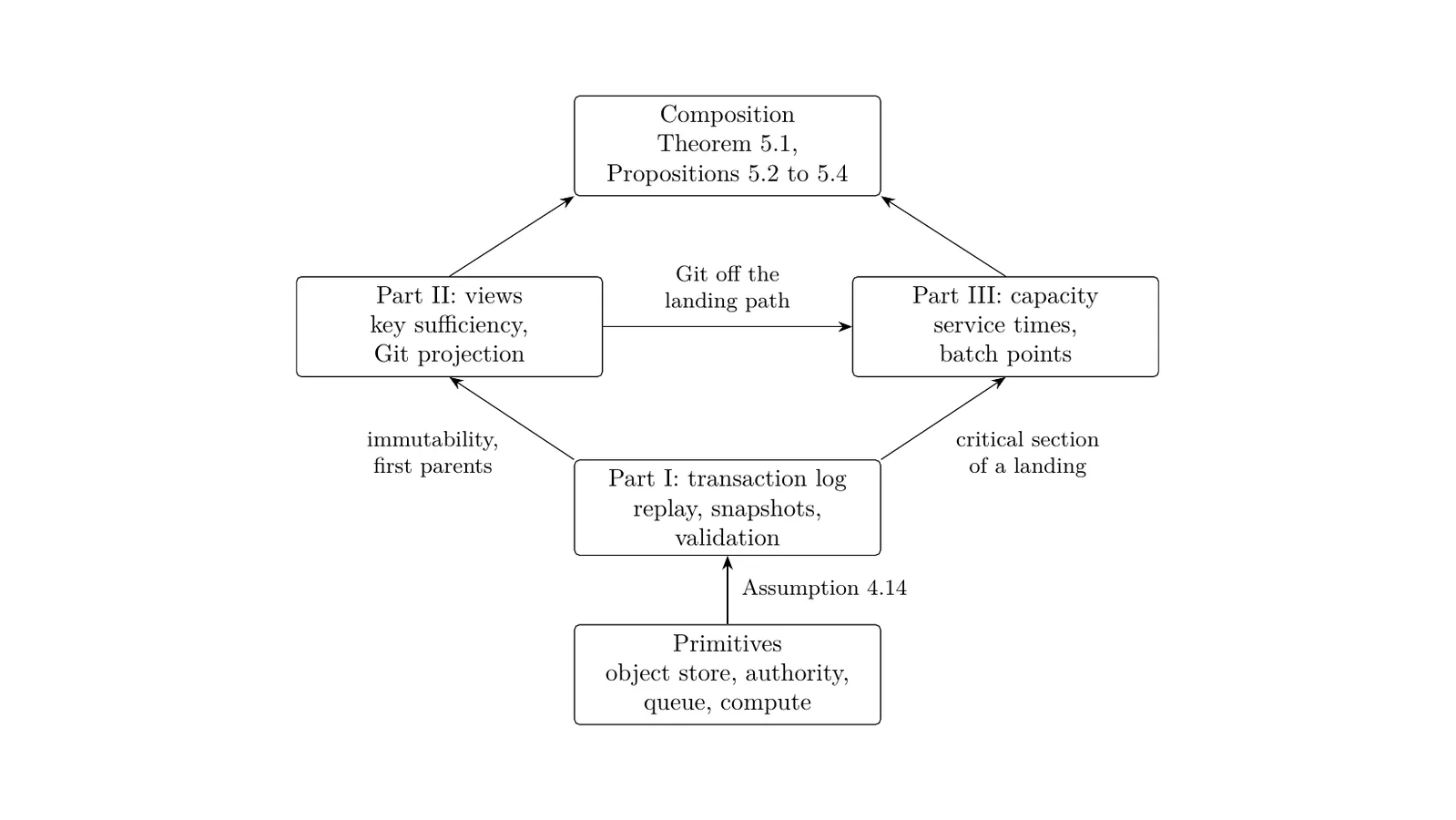
- Part I: the transaction log. A hash-chained log of ref changes, snapshots and checkpoints, validation of declared reads and writes, and a serializability theorem. It also found where group landing fell short: two batch members that each read what the other wrote could land together (write skew). A pairwise check removes it.
- Part II: derived data as views. Search indexes, symbol tables and check results are partitioned jobs over immutable snapshots. A view is consistent at a snapshot when the key of each stored result determines that result. The Git commit of a branch is one of these views: a deterministic function of the log prefix.
- Part III: the system on cloud primitives. It measures the design on one cloud deployment, and models where the serialized authority saturates.
The composed result is one no single part states. Every guarantee in Part I is written over log entries rather than Git objects, and Part II shows Git is a view of the log, so Git objects can leave the landing path without weakening any guarantee. The authority's work per landing shrinks to a validation query and an append, and Part III's capacity model says a branch is limited by one serial call per batch, not one per landing.
How YonedaRepo uses it
YonedaRepo is the reference implementation, first-party work that is still being built. In the measured revision (fef94e7), every waiting landing on a branch goes to the authority in one call of up to 256 landings. Path-disjoint landings are appended as changesets, landings on the same files go to the merge path, and a member whose reads or writes meet an earlier member's writes is deferred. Commits are recorded in 64 commit shards, reads of main come from a published head, and Git commits are projected from the log afterwards.
What was measured
All measurements come from one isolated cloud deployment with a synthetic workload: each writer commits one new file on main and lands it, with no conflicting writes and no declared reads. Landing p95 is client-side, over successful requests.
| Revision | Landing path | Writers | Landing p95 (s) | Landed |
|---|---|---|---|---|
| dd6c9a8 | Polling, Git built | 1,000 | 104.0 | 4 of 1,000 |
| dd6c9a8 | Combiner, Git built | 1,000 | 64.8 | 385 of 1,000 |
| dd6c9a8 | Changesets | 1,000 | 18.7 | 1,000 of 1,000 |
| fef94e7 | Batched changesets, one token per writer | 1,000 | 1.21 to 1.87 | 1,000 of 1,000 in 3 runs |
| fef94e7 | Batched changesets, one shared login | 1,000 | 2.17 to 3.03 | 1,000 of 1,000 in 3 runs |
The dd6c9a8 rows are a controlled comparison on one deploy and one client. The two modes that built Git trees during landing landed 4 and 385 of 1,000; appending changesets landed all 1,000. The comparison varies the whole landing path, so it does not isolate the cost of building Git objects.
On fef94e7, all six 1,000-writer runs landed every writer with nothing refused as overloaded, and all 1,000 reads returned correct content. On an earlier revision that served reads from the authority, 540 of 1,000 reads succeeded and 460 were refused. Main's Git commit trailed the log by 3.2 to 5.4 s at p95. Commit p95 was under 1 s in two of the three one-token runs and missed 1 s in all three shared-login runs.
Limits the paper states
- No sustained landing rate has been measured. Burst-span rates of 235 to 491 landings per second are averages over bursts of 2.7 to 4.3 s.
- The write-skew check has never run on a workload that could trigger it, because every writer writes its own file and declares no reads.
- Views are consistent at a snapshot, not fresh. No bound on the Git delay is proved.
- The implemented search view breaks key sufficiency, so renamed or duplicated directories can return wrong paths. Part II proves two repairs.
- Serializability holds per ref, with no atomicity across refs or repositories.
- The model was tied to the code by reading it at pinned commits, not by mechanized verification. Part IV later machine-checks the core of Part I's model in Lean 4; its theorems also concern the model, not the code.
Read the paper
More posts
Research at YonedaRepo: five papers behind the platform
YonedaRepo rests on a research series, Source Code as a Transactional Abstraction. Here is what each of its five papers covers, and the post that explains each one.
Research
What a repository looks like when you run it like a database
Part I treats a repository as a database with a transaction log. Commits are built on the server, landing is validated against the log, and lost races stop costing a rebase.
Research
When is a cached index still correct?
Search indexes and blame are views of a commit. Reusing them is correct exactly when the storage key determines the result. Our search key did not, and the proof found the bug.
Research