Proving that a batch of landings is serial, in Lean
When many agents push to one main, landing changes strictly one at a time costs one call to the branch's serialized authority per change. So YonedaRepo batches: a combiner lands many changes in one call.
The combiner checks each member against the committed log, but not against the other members of the batch. Part IV asks when landing a batch at once equals landing its members one after another, and answers with a proof Lean has checked.
The failure batching can cause
The paper's smallest example is write skew. Start with x = 0 and y = 0. Change ca reads x and sets y := x + 1. Change cb reads y and sets x := y + 1. Both are built on version 0, and an unrelated entry c0 that writes only z has landed since.
Checked alone against the log, each change is a clean Rebase, and their write sets are disjoint. The batch installs x = 1 and y = 1. Running them in the order ca, cb gives y = 1, x = 2; the order cb, ca gives x = 1, y = 2. The batch matches neither serial order. Landed one at a time, the second would have been refused as a Conflict.
Part I of the series showed this and proposed a pairwise rule, proved by hand for fast-forward and rebase members. Members validated as Merge, whose writes overlap something that landed meanwhile, were left out.
The idea
A change is a transaction with a declared read set R, a write set W and a function from states to states; locations are paths in a tree. Landing validates a change against everything written since its base: Conflict if something it read was written, FastForward if nothing landed, Merge if its writes overlap a later write, and Rebase otherwise.
A batch is accepted when every member validates as FastForward, Rebase, or a Merge with no conflict path, and the members satisfy the pairwise rule: no member reads or writes anything an earlier member, in ticket order, writes. In Lean:
def BatchRule (ci cj : Txn) : Prop := meetsSet (cj.R ++ cj.W) ci.W = falseMerged members need one more condition, patch compatibility. A merged change has two readings: run the change on the current head, or apply the diff it made against its own base to the head. Patch compatibility says the two agree on the change's write set.
How YonedaRepo uses it
YonedaRepo's landing path has the model's shape. yoneda reads add records declared reads and yoneda push sends them; landing refuses a push whose reads changed on main meanwhile. Otherwise the platform merges on the server, batching landings on a busy branch into one merge commit. Part I describes the check that enforces the pairwise rule.
The series' synthesis treats batch size as a capacity parameter with no cost in isolation. The theorem below is what that rests on, now including patch-compatible merged members.
What was proved
The headline theorem, as the paper prints it:
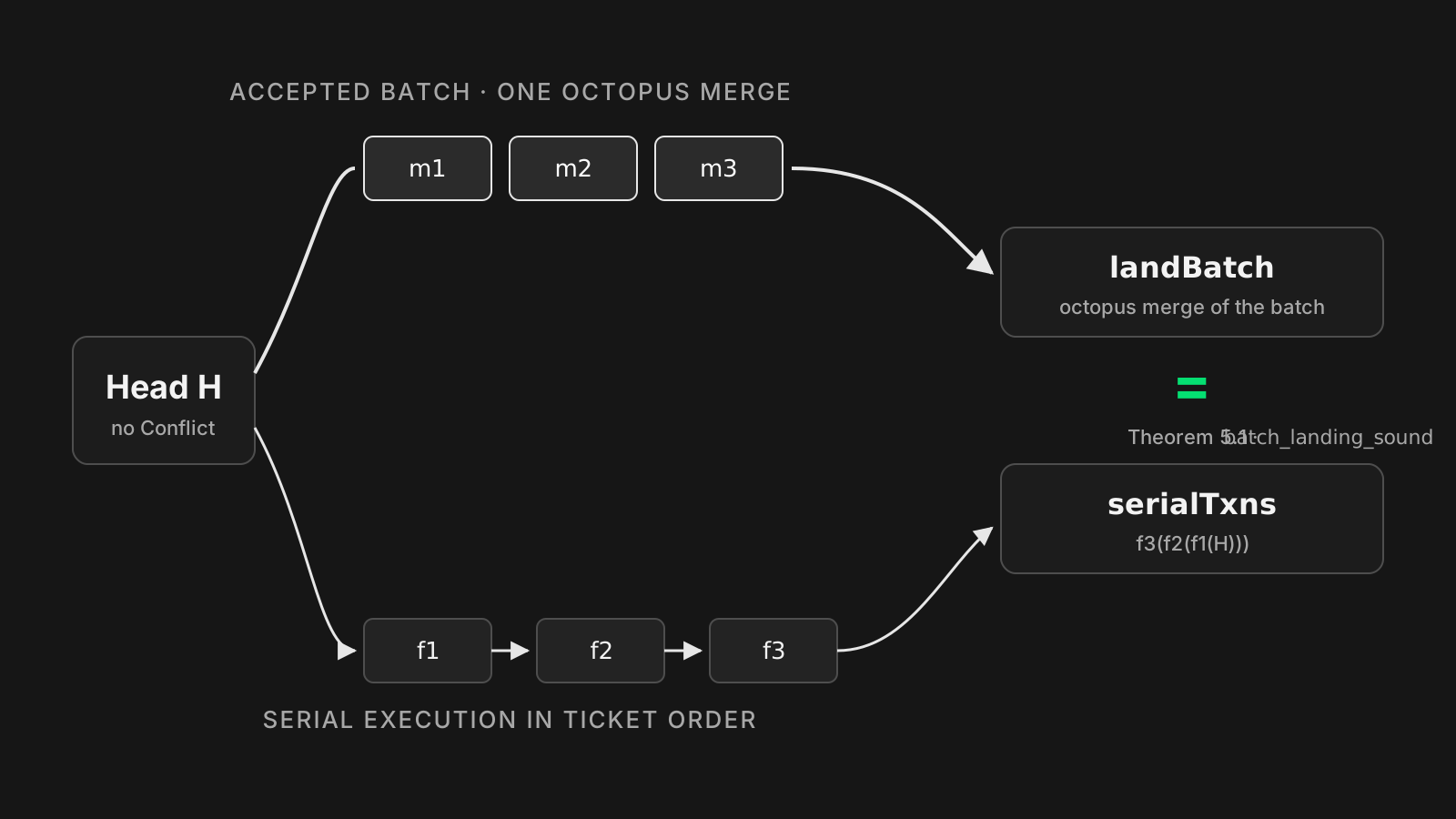
theorem batch_landing_sound (hlog : NoConflict log) (hacc : BatchAccepted init log ms)
    (hpatch : ∀ e ∈ ms, validateAt log log.length e.txn.R e.txn.W e.base = .merge →
      PatchCompatible (toMember init log e) (snap init log log.length)) :
    let H := snap init log log.length
    let batch := landBatch H (ms.map (toMember init log))
    batch = serialTxns H (ms.map (·.txn)) ∧
    snap init (log ++ ms) (log.length + ms.length) = batch ∧
    ∀ i, ¬ SReach (log ++ ms) i i
In words: given a log with no Conflict landing, an accepted batch at its head H, and every Merge member patch-compatible with H, the batch state equals serial execution in ticket order, the log with the members appended ends in that state, and the serialization graph over declared accesses has no cycle.
The proof chains three lemmas. The octopus merge equals landing members one at a time (landBatch_eq_seqLand), which equals a sequence of three-way merges (seqLand_eq_serialMerge), which equals serial execution (serialMerge_eq_serialTxns).
Neither extra hypothesis can be dropped, and both counterexamples are checked in Lean:
- Without the pairwise rule, the write-skew batch above is accepted, matches neither serial order, and leaves a cycle in the serialization graph (
batch_rule_needed). - Without patch compatibility, one blind write is enough. A changeset declares
W = {x, y}, reads nothing, and carriesx = 0andy = 1. Meanwhilexbecame 1. The merge keepsx = 1and setsy = 1; running the change on the head givesx = 0(merge_not_serial).
That member reads nothing and its merged path is outside its read set, the two conditions you would try first. Patch compatibility is exact for one member: a conflict-free merged landing equals running its transaction on the head if and only if it holds (merge_serial_iff). For a changeset it means the change never writes a stale base value back over a path the head moved.
The hypotheses are not vacuous. A witness batch merges edits to two lines of one file, F/1 := 11 and F/2 := 21, with a member that increments G, and equals serial execution with F/1 = 11, F/2 = 21 and G = 1. Lines are modelled as child locations with stable keys, so edits to different lines merge cleanly.
| What the paper reports | Value |
|---|---|
| Theorem declarations, helpers included | 180 |
| Lean | 4.35.0, core only, no Mathlib |
sorry, admit or declared axioms | none |
| Main theorems in the axioms report | 72 (6 on propext alone, 66 on propext and Quot.sound) |
| Adversarial review rounds | 2 |
| Clean build | about 3 s wall-clock on the author's machine |
Formalizing also corrected Part I in four places. The most practical: Part I's merge rule makes two identical changes conflict, so two agents applying the same fix to one file would be told they conflict. The corrected rule adds the diff3 and Git clause that identical changes merge to that change.
Limits the paper states
- The theorems concern the model, not the implementation. YonedaRepo is linked to the model only by reading code at named commits. The implementation is not verified.
- Whether the implementation's merged landings are patch-compatible is unknown. Checking the condition at landing, or restricting changesets to paths whose content they change, would close that gap for changesets.
- The merge is idealized. Lines have stable keys; positional diff3, where insertions shift later lines, is not modelled, and the corresponding laws fail for it.
- Validation works at one granularity and the log has one ref, so several mappings to Part I are adapted. Some of Part I's results, such as replay determinism and tamper evidence, are not formalized.
- Reads a writer does not declare are not protected. Under the write check no landed update is lost, but serializability can fail.
Read the paper
Read the paper or download the PDF. The Lean sources are in the lean/ directory of the research repository.
The rest of the series: Overview, Part I, Part II and Part III.
More posts
Research at YonedaRepo: five papers behind the platform
YonedaRepo rests on a research series, Source Code as a Transactional Abstraction. Here is what each of its five papers covers, and the post that explains each one.
Research
Repositories are becoming databases
Data lakes moved from directories of files to tables with a transaction log. This series argues source control is making the same move, and shows what each part contributes.
Research
What a repository looks like when you run it like a database
Part I treats a repository as a database with a transaction log. Commits are built on the server, landing is validated against the log, and lost races stop costing a rebase.
Research