Testing with real agents in a sandbox
YonedaRepo is built for agents, so we test it with real ones. But a coding agent with shell access is untrusted code with a model attached. This post describes the sandbox we run them in and what the latest run showed.
Three levels
Our live test kit checks agent behavior at three levels:
- Git semantics, no model. Protocol v2, partial and shallow clones, two
yoneda::clones pushing, pulling, merging, rebasing, cherry-picking and reverting, a same-line conflict refused and resolved, a change opened and landed with the CLI, and a 1 MiB LFS file round trip. - Agent hooks, no model. A scripted session runs through the real hooks: it starts with a context naming earlier sessions, records a read, is refused a plain push while reads are pending, pushes with the read declared, and its session record reads back.
- Real agents, paid. N agents each get their own clone and token, and all edit the same file and the same changelog, then push to
mainat once. Then a second wave.
The sandbox
Every agent runs in its own Docker container:
- the agent's clone is the only host path mounted;
- no host environment, configuration, GitHub CLI or SSH agent;
- the model credential arrives on stdin;
- egress reaches the internet and the platform's port, but not the host or the local network;
- the container refuses to start unless the clone's origin is the test repository.
Around the run, the host's checkouts and their remotes are snapshotted. Any change, to HEAD, a branch, status, a worktree or a remote ref, fails the test loudly.
The October 28 run
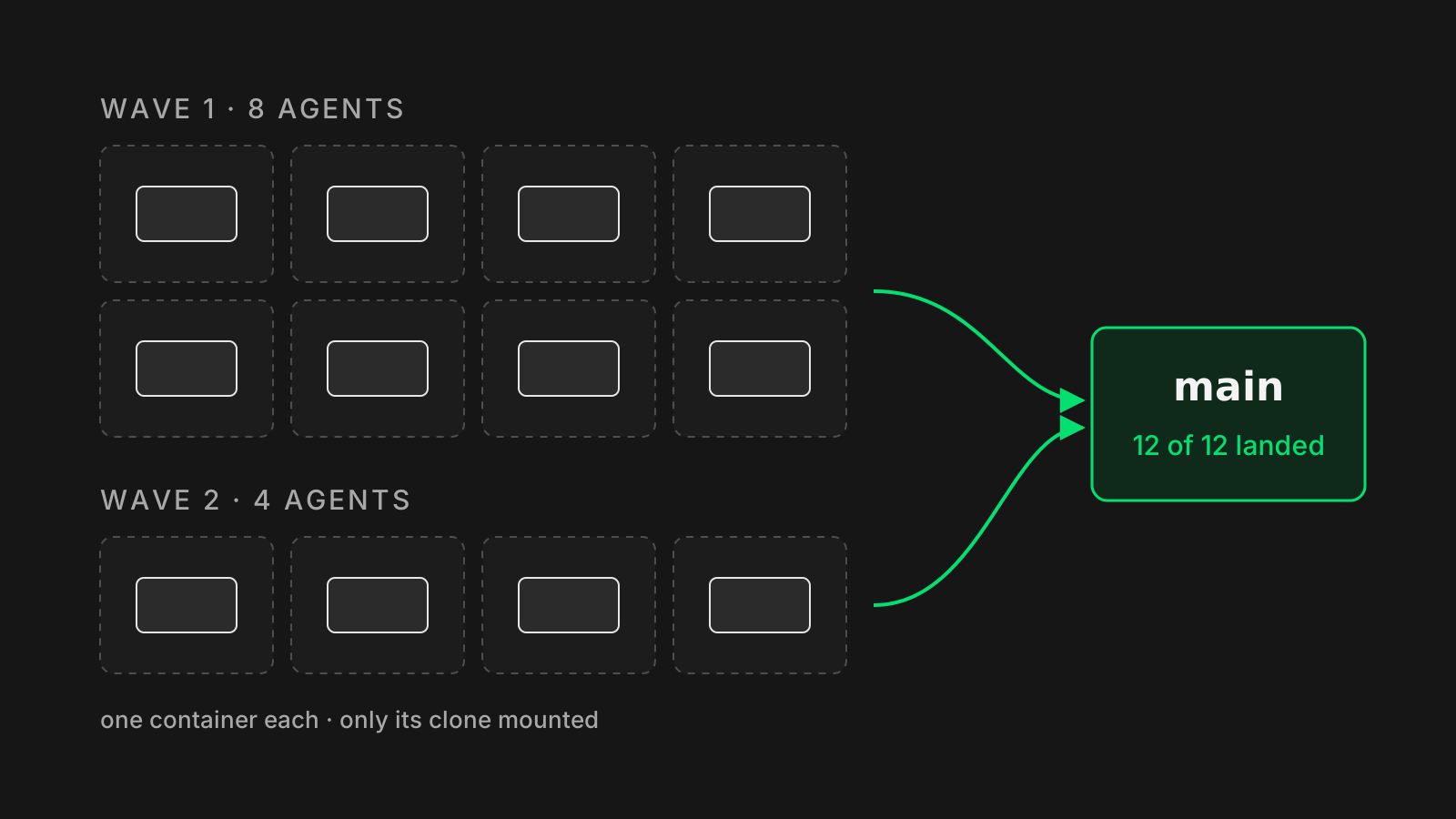
Eight opencode agents on the GLM-5.3 model, then four more, all on one repository:
- 12 of 12 agents exited cleanly, each within its 600 s limit (15–124 s each; 214 s for the whole item).
- 12 agent commits reached
main, and no clone made a merge commit. - 12 session records, one per commit. Each second-wave agent's starting context named the first wave's sessions.
- The host checkout and both remotes were unchanged.
What did not go as well
The day before, four agents per CLI on one repository: opencode landed 4 of 4, with one conflict resolved by a single resume. Claude Code on the same GLM model landed 2 of 4; two agents reported having no file tools. That is still an open item.
We also compared token use on one small task. Agents using the yoneda read tools used more input tokens than agents working from a plain clone: 121.6k mean versus 52.7k. On a small repository, reading on the server saved nothing, and our counter of whole-file reads was wrong in both arms. We publish that because it is what we measured.
More posts
Introducing Flight Path
Every change on YonedaRepo gets a route, from the plan an agent files to the record it leaves after landing. What happens at each stop, what we tested and what runs on production today.
EngineeringLandings replace the pull request
When agents write the code, review has to start from evidence. How a Landing works, and what happened when a real agent went through one and nobody pressed Land.
EngineeringMeet Tower
Tower clears code for landing with rules alone. It warns sessions about traffic, holds Landings that would collide and puts them in order. It writes no code and starts no agents.
Engineering